
Caught Up
A Brief History of the Rapture

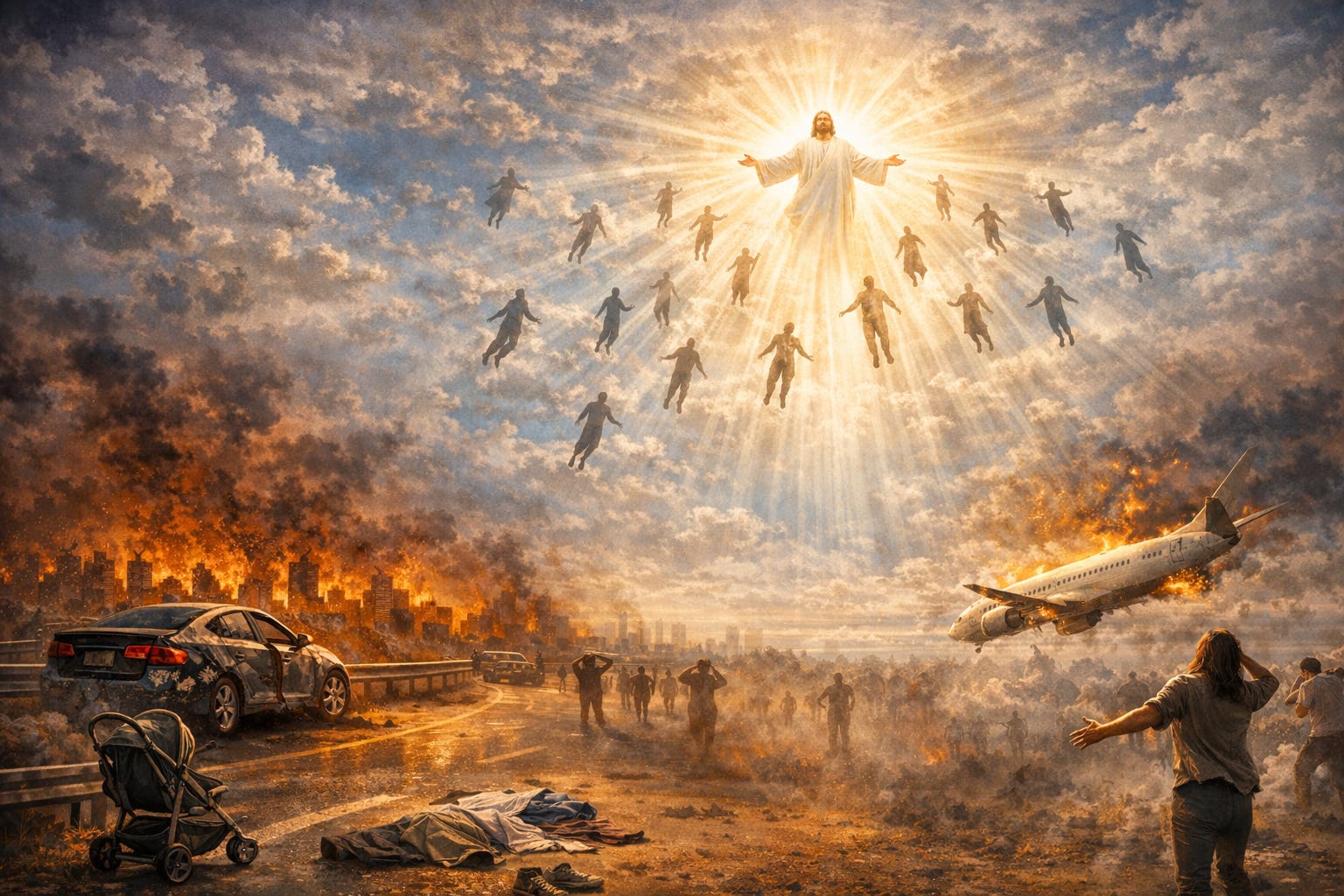
If you ever attended any evangelical church in the U.S., the idea of the Rapture is a given. Even people who are not Christian or religious are familiar with the basic concepts of this belief. One moment the world is normal. The next, millions of people vanish into thin air. Planes fall out of the sky. Cars crash into each other. Clothes are abandoned on the ground.
Kirk Cameron made a sort of a career comeback with the Left Behind films, which were in turn based on the bestselling novels of the same name. These were everywhere in the late 90s and early 2000s. Even Nicolas Cage made a remake of the first movie just a few years ago.
Now, I grew up Catholic for the first decade of my life, and still attended mass a few times over the next few years, and I never heard of the Rapture.
So, where did this idea come from?
Was the Rapture something Christians had always believed? Or was it a more recent interpretation of biblical prophecy?
The answer turns out to be far more interesting than most people realize.
Early Christians and the End
From the earliest days of Christianity, believers expected Christ to return.
The New Testament speaks about a future moment when Christ would return, the dead would be raised, and God’s kingdom would be fully established.
One passage that often comes up in discussions of the Rapture is found in 1 Thessalonians 4, where the apostle Paul writes that believers will be “caught up… in the clouds to meet the Lord in the air.”
At first glance that language can sound very similar to the modern Rapture concept. But historically, early Christians understood the passage differently than many people do today.
For the first centuries of Christian history, believers interpreted these verses as part of a single, dramatic return of Christ at the end of time. When Christ returned, the dead would be resurrected, the living would be transformed, and the final judgment would take place.
In other words, the “catching up” of believers was not viewed as a separate event that occurred years before the end of the world. It was simply part of the final moment when Christ returned to bring history to its conclusion.
This interpretation remained the dominant view throughout the early church.
Influential theologians over the centuries like Augustine of Hippo and Thomas Aquinas helped shape and cement this understanding. In fact, for nearly 18 centuries, Christians across the Catholic, Orthodox, and even Protestants traditions agreed on this point: Christ would return once, visibly and publicly, at the end of history.
A New Interpretation Emerges
The modern concept of the Rapture did not begin to take shape until the early nineteenth century.
The central figure in this development was John Nelson Darby, an Anglo-Irish theologian and one of the early leaders of a movement known as the Plymouth Brethren.
Darby developed a theological framework that would later become known as dispensationalism.
Dispensationalism divides history into a series of distinct periods—or “dispensations”—in which God interacts with humanity in different ways. One of the most important features of Darby’s system was a strong distinction between Israel and the Church in God’s prophetic plan.
According to Darby’s interpretation, many biblical prophecies concerning Israel would be fulfilled during a future period of intense suffering often called the Great Tribulation.
Because the Church was not part of this particular prophetic program, Darby concluded that believers would be removed from the earth before that tribulation began.
This removal became known as the Rapture, a term derived from the Latin word rapturo, meaning “to seize” or “carry away.”
First would come a hidden or “secret” return in which believers would suddenly be taken up to meet Christ. After a period of tribulation on earth, Christ would return again, this time publicly, to establish his kingdom.
This interpretation was dramatically different from the traditional view that had dominated Christian theology for centuries.
I do want to point out that there is some debate about the origins of this doctrine. Some scholars argue that Darby was either inspired or copied the ideas of a young Scottish woman named Margaret MacDonald. In 1830, MacDonald reportedly experienced a prophetic vision during a period of illness and intense religious revival in the town of Port Glasgow. Although not exactly the same as Darby, there is still enough similarity to point this out.
How the Rapture Spread in America
While Darby helped develop the theological framework, the Rapture gained its greatest influence in the United States. One of the most important factors in its spread was the publication of the Scofield Reference Bible in 1909.
Compiled by American theologian Cyrus I. Scofield, this Bible included extensive study notes explaining biblical passages through the lens of dispensational theology. For many readers, these notes became an authoritative guide to understanding prophecy.
The impact was enormous. Bible institutes, prophecy conferences, and evangelical seminaries began teaching dispensational interpretations of scripture. Over time, these ideas became deeply embedded in American evangelical culture.
For many believers, the Rapture simply became the default way of understanding the end times.
This all got exacerbated by the Cold War. The threat of nuclear destruction suddenly made the end of civilization more real than ever in human history. Events such as the establishment of the modern state of Israel in 1948 were interpreted by many believers as signs that ancient prophecies were being fulfilled in real time.
In 1970, author Hal Lindsey published a book called The Late Great Planet Earth. Lindsey interpreted contemporary world events through the lens of dispensational prophecy and suggested that the end times could arrive within the current generation. (Spoiler Alert: It didn’t)
A Working Theory
With the war in Iran right now, you’re seeing more of this chatter online. Evangelical Christians are almost giddy at the thought of another world war starting. Why? Because they believe that this will usher in the beginning of the Rapture.
Recently, the Military Religious Freedom Foundation had over 200 complaints from service members being told by their commanding officers things like, “Donald Trump was anointed by Jesus to light the signal fire in Iran to cause Armageddon and mark his return to Earth."
One working theory that I have is that evangelicals are terrified of death and the idea of being caught up in heaven with Jesus, without tasting death, is too irresistible for them. Are they willing to burn the entire world to prove this doctrine? I believe so. This is what psychologists call Terror Management Theory, which argues that humans construct belief systems that help manage anxiety about mortality. But that’s not the only reason. Not only will the question of their own mortality be solved, but they will also feel vindicated. They were right. Everyone else was wrong.
Do I believe in the Rapture?
No. I used to, back when I was in those evangelical circles over a decade ago, but not anymore. It goes against 18 centuries of tradition and scholarship and it has been used by politicians to justify all kinds of reprehensible acts in the Middle East.
I refuse to be a pawn in the geopolitical games by the religious right.
What do you think?
Thanks for reading.
Further Reading:
Inside the Movement That Changed American Faith

Nearly twenty years ago, I was in Hamilton, Alabama, listening to Lou Engle discuss the Seven Mountains Mandate. What is now mainstream Christian Nationalism was then just a movement in what felt like the middle of America. I had driven up from South Florida with a group of friends from my youth group. It’s an understatement to say we felt out of place …
Somewhere Between God and Country

I don’t even know where to begin or end this post. It’s going to be the beginning of an ongoing conversation with you. There are so many different feelings mixed with decades of trauma and fears that it’s hard to unpack this suitcase of religiosity.
-https://en.wikipedia.org/wiki/Dispensationalism
-https://www.theguardian.com/world/2026/mar/03/us-israel-iran-war-christian-rhetoric
-https://www.goodreads.com/series/50162-left-behind
Thanks for this piece! When I was a teenager, my Dad's church put on the conversion training class that featured Kirk Cameron and Ray Comfort (whoever second dude is), I believe it's called "The Way of the Master". It goes more or less like this: walk up to randos on the street, ask them if they know the 10 commandments, let them name a few, ask them if they've ever broken any of those, let them say yes or draw a yes out of them, make sure they know they're going to hell unless they repent and, if you're "successful" ig, pray with them blah blah.
Personally, I think the best way to keep heaven on earth from coming is to tell people that they will burn in hell unless they engage with your ritual of repentance. Some people will burn the whole world to prove that humans can't be good to each other without their idea of god, their rituals, their words.
Thanks for this; I wish more folks knew about the history of the rapture. Terror Management Theory is a new term for me.